

Welcome to The Cost of Intelligence, our new comedy news show about the money behind AI. Each episode, Ben Sand reads the industry’s invoice and asks one question: are you getting more intelligence per dollar?
This week: token spend more than doubled since May, a free-weights DeepSeek model ate OpenRouter’s top ten for breakfast, and NVIDIA’s Rubin page quietly lists less memory bandwidth, after the buyers had already signed. Here’s the written version, with every source linked.
Who’s paying
The four biggest spenders, Microsoft, Amazon, Meta and Alphabet, put $201.9B of cash into CapEx in calendar Q3 2026, against $97.3B a year earlier. That’s more than double.
Now the money people are reading the invoice:
Meta: S&P moved its AA- credit rating to a negative outlook (CNBC). Investing.com reports the S&P note sees Meta’s CapEx above $225B in 2027 (Investing.com). For scale, Meta spent $28.1B in 2023, so that’s roughly 8x. Its CapEx went from $31.4B in 2022 to $72.2B in 2025, with $135B to $145B guided for 2026 (2023 results, 2025 results, Q3 2026 results).
Anthropic: the Financial Times reports that Blackstone, which is financing Anthropic’s chips, told deal investors it expects Anthropic to get a BB rating after its IPO. That’s high junk (FT, paywalled; TechCrunch).
SpaceX, which now owns xAI: rated investment grade (BBB, Baa1, BBB+) right after its June IPO (Reuters).
Oracle: sits one notch above junk at BBB-, after S&P cut it on 9 July over AI spending (S&P, WSJ).
Railroad math
Junk does sound scary. But think railroads: giant fixed costs now, revenue later. In the 1870s, railroads ran on exactly that kind of debt. After the Panic of 1873, defaults reached just 35.9% of US corporate bond par value between 1873 and 1875 (NBER w15848; Cotter, “Off the Rails”).
Should be fine.
The trains are full
Meanwhile, demand isn’t the problem. Google says its model APIs now handle nearly 32 billion tokens a minute, more than 4x a year ago (Alphabet Q3 2026). Multiply by the 1,440 minutes in a day and that’s about 46 trillion tokens a day, from Google alone.
Google rents out chips too. Google Cloud revenue came in at $30.7B, against $15.2B a year earlier, partly from selling its own TPU systems (Alphabet 10-Q).
The landlord has entered the chat
Agents need somewhere to live, and the landlords are the big clouds and the neoclouds that rent out the chips.
B200: Silicon Data has a B200 at $6.50 an hour on 1 November. That’s up from $5.86 on 3 October (about 11% in a month) and from $4.40 on New Year’s Day (almost half) (Silicon Data B200; March update).
H100: the big clouds still charge a premium. Azure lists an H100 at $12.29 an hour on demand (Azure retail prices API), against $2.92 on Silicon Data’s H100 rental index on 31 October (Silicon Data H100).
Twelve dollars. For one hour. And the landlord still won’t fix the AC.
The news
Spend up, price down
a16z’s Moses Sternstein did napkin math on Ramp and OpenRouter data and put token spend at more than double since May. Then he said nobody should trust those samples, including himself (a16z, Charts of the Week). Respect.
Meanwhile, Silicon Data’s token price index is down 54% from its May peak (Axios). Half price, and the bill still went up. William Stanley Jevons, now that is a paradox.
Per-dollar verdict: more dollars, more tokens. Ask us again when the data’s real.
DeepSeek eats OpenRouter
On OpenRouter, the model marketplace, DeepSeek V4.1 Flash (1017) took 38% of the top ten’s tokens in the week to 31 October, with its tokens up more than half on the week before. Add the other V4.1 Flash listing and the two hold half the top ten’s tokens (OpenRouter rankings).
It’s a free-weights model, and the developers are lifting it hard. Even OpenAI is going small, with two of its Luna small models in the top ten.
Per-dollar verdict: smarter per dollar. The cheap, fast models are where the volume lives.
NVIDIA’s Rubin spec sheet changes
NVIDIA’s Vera Rubin NVL72 page now lists 19.2 TB/s of memory bandwidth per GPU (NVIDIA). TechRadar reports it used to say 22 (TechRadar), and another NVIDIA page still does. AMD’s MI455X lists 23.3 TB/s (AMD), so AMD’s lead got wider.
But the buyers signed before the spec sheet changed:
On its August earnings call, NVIDIA said every major hyperscaler, AI cloud and system maker had already placed Rubin orders, and that supply stays tight at least through fiscal 2028 (NVIDIA Q2 FY2027 call).
OpenAI has 2 GW of training lined up on Vera Rubin (OpenAI). Anthropic committed up to 1 GW on Grace Blackwell and Vera Rubin (Anthropic).
In October, after NVIDIA’s page already showed the lower figure, AM Intelligence ordered more Rubins for about 29,000 in all, in a $6B build (AMI release; The Hindu). By our math, that’s roughly $200K a chip, all in.
That’s 0.41% of the roughly 7 million Rubins NVIDIA could ship in 2027, per TechFlow’s write-up of Morgan Stanley’s 8 July note (TechFlow).
The scarce thing is your place in line. Memory bandwidth is how fast the chip can feed itself, and for serving tokens, that’s the whole game. On paper, less bandwidth means fewer tokens a second, so if the price holds, every token costs a bit more. Neither chip has public benchmarks yet, though.
Per-dollar verdict: on paper, fewer tokens per dollar than the buyers signed up for. But nobody’s cancelling.
The tier list
Built on Adam Holter’s chart of how much API usage you get for every dollar of subscription.

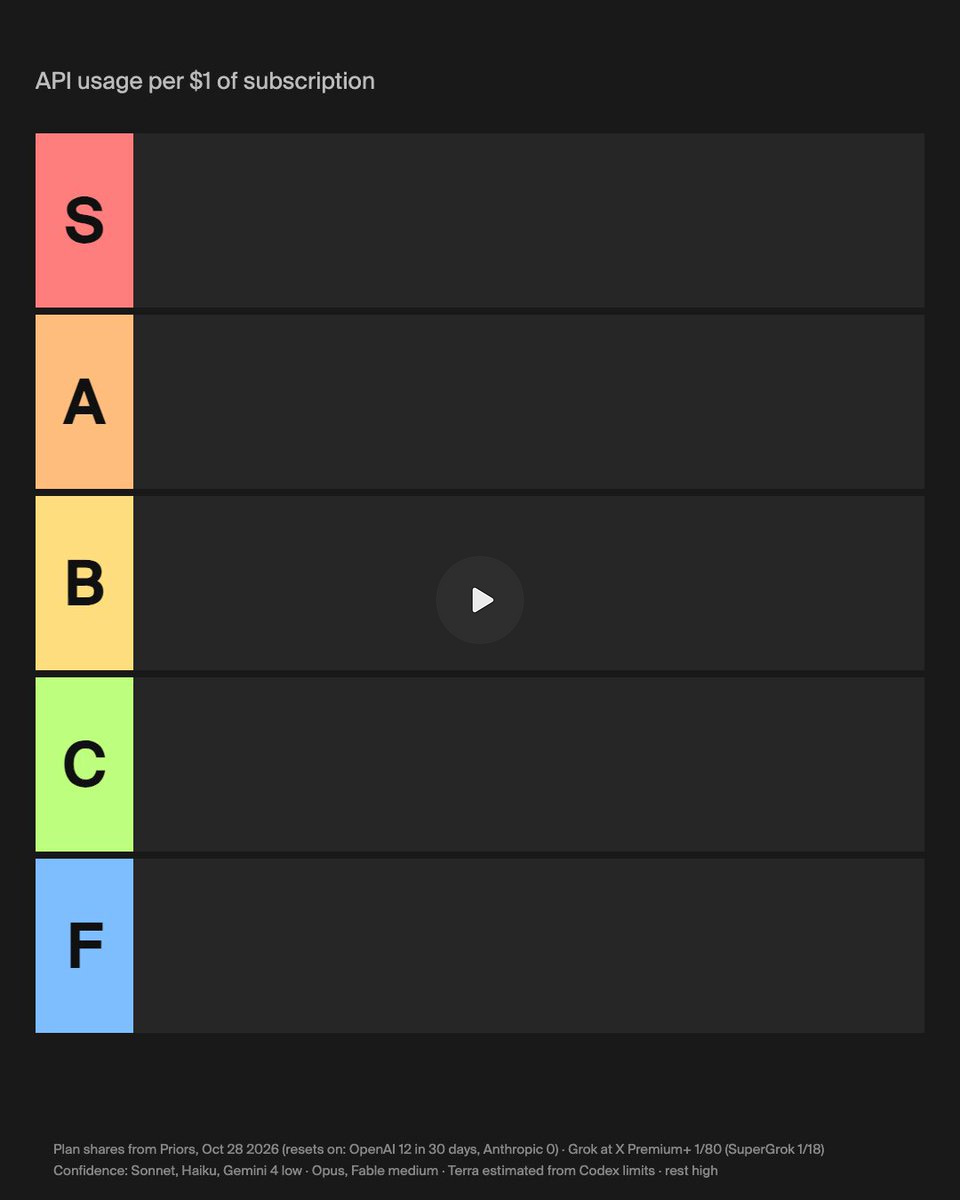
Plan prices: Claude pricing.
Top of S tier: Claude’s $100 Max plan on Opus 5.5. Adam reckons every dollar gets you about $77 of API usage.
Today’s mover is just a rename: Max 20X is now called Ultra. Same $200, still about $66 of API usage per dollar.
Counting finished tasks instead of tokens: the value pick is GPT-6 Luna on ChatGPT Plus, at about 16 coding tasks a dollar on our math.
Adam’s question of the weekend: why pay API rates for Opus when the plan is subsidised that hard? At list prices, somebody’s eating the difference, and for now, it’s not you.
Department of Token Efficiency
Somebody out there cut their AI bill. Today’s cost destroyer is Matt Bernier (his write-up).
His team is mostly AI coding agents, and his agents open pull requests. Lots of them. So many that their 3,000 free monthly minutes of GitHub testing lasted about 27 hours in October. The agent flood pushed their testing bill to 76 cents a pull request. They got it to 16 cents, mostly by moving to Ubicloud runners at a third of GitHub’s per-minute price, and by no longer running tests nobody needed.
The fine print: this is the testing bill, not the token bill, for one repo, measured from the peak of the flood. Against where they started, it’s only about 29% cheaper, in his own words. And his first three clever fixes made it worse.
If you’d rather build your own runner than rent one, we wrote up how we built ours a couple of years back: test runs went from about 22 minutes on GitHub to about 7 on our own metal (Maximising GitHub Actions Efficiency). Turns out agents run up the bill on everything around the tokens, too.
A word from ourselves
Strong Compute plugs into the compute clouds and model providers you already use, from AWS and Lambda to OpenAI and Anthropic. Bring your own keys and see exactly where the GPU hours and tokens go.
Because somebody has to read the invoice.
Try it at strongcompute.com
Keep your context short and your invoices shorter. See you next episode.