

Listen to this episode on Spotify or watch it on YouTube.
Welcome back to The Cost of Intelligence, our comedy news show about the money behind AI. Each episode, Ben Sand reads the industry’s invoice and asks one question: are you getting more intelligence per dollar?
This week: Anthropic starts trading on Nasdaq, priced above its range, with a filing that commits it to $900.9 billion of future spending. The company that sells tokens by the million is going public by the trillion. Our first Throughput Thursday prices the top models per task instead of per token. Nvidia’s Data Center sales more than doubled; somebody’s been shopping. A new US rule puts a license on renting big AI clusters to Chinese companies; the clouds will need to see your ID. And the Department of Token Efficiency has three cuts, from Perplexity, OpenClaw and PostHog. Here’s the written version, with every source linked.
Throughput Thursday
Our first one. Be gentle. It’s a baby.
Throughput is how much work a dollar buys, so we price it per task. Price per token is the sticker. Price per task is the out-the-door price. Miles per gallon, if the car also wrote your emails.
Artificial Analysis is an independent tester. Its Intelligence Index gives every model on its board the same nine tests, from coding to science (methodology), and adds up the bill. Wednesday’s numbers:
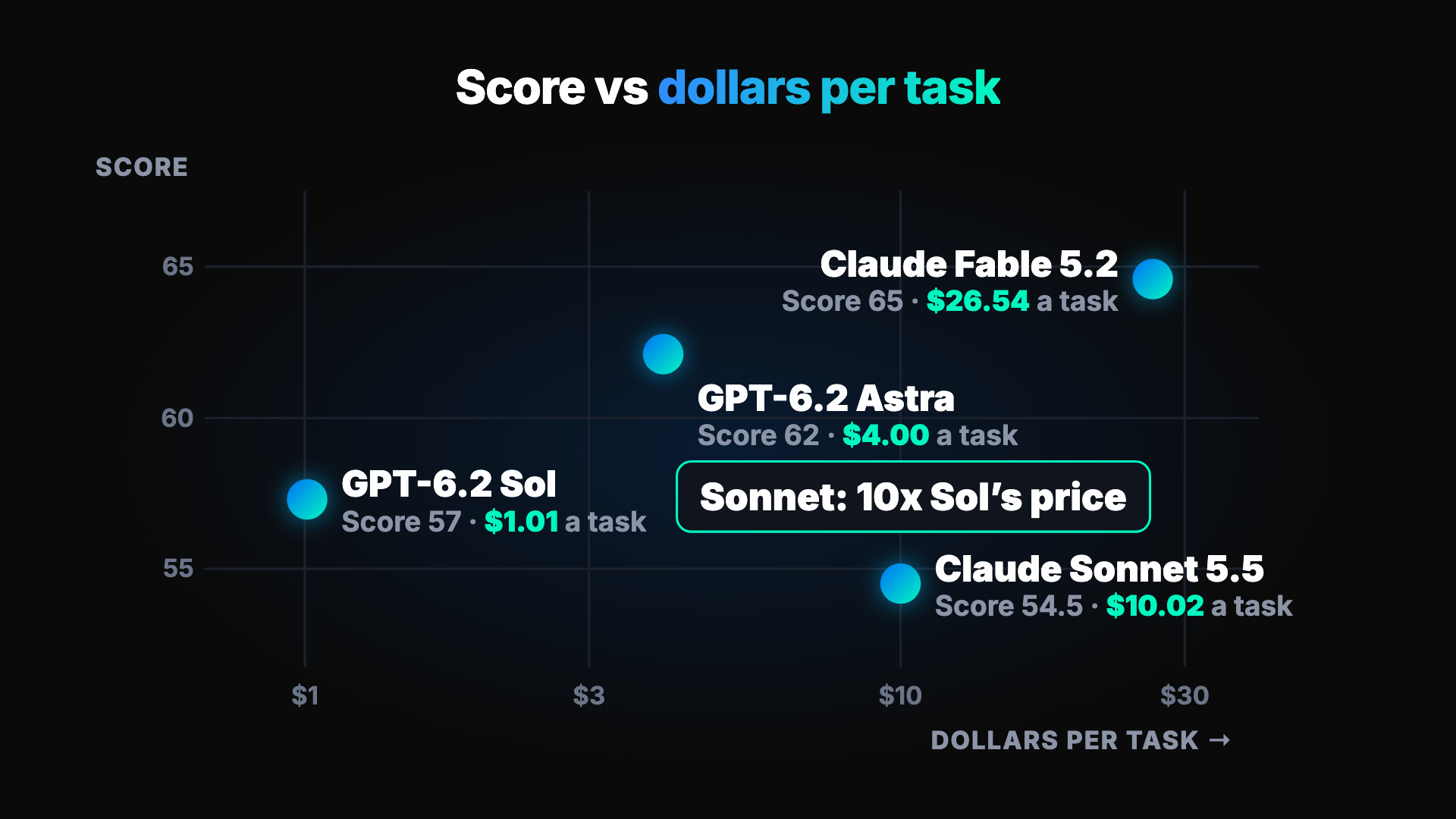
Claude Fable 5.2 (Anthropic): index score 65, $26.54 a task
GPT-6.2 Astra (OpenAI): 62, $4.00 a task
GPT-6.2 Sol (OpenAI): 57, $1.01 a task
Claude Sonnet 5.5 (Anthropic): 54.5, $10.02 a task
Fable scores highest, a couple of points above Astra, but its task costs 6.6 times as much. More score, for more money. Extra credit, at private-school prices.
Sol is the bargain: a task costs about a dollar. Astra’s little sibling works for pocket change.
Sonnet 5.5 is the opposite: about 10 times Sol’s price, for a lower score. A downgrade with a premium.
On December 1, Google doubles what Gemini 4 Carbon charges per token, from $2 to $4 per million input tokens and $10 to $20 per million output (Google pricing). Artificial Analysis puts Carbon at $7.76 a task at the new price, almost twice Astra. Pay by the token, and you pay more for the same answers. Sticker shock, now with a delivery date.
The catch. A price per task assumes the task gets done once. Developer Matt Shumer posted that he gave Astra a job as a sub-agent, and Anthropic’s top models ended up redoing the work:

That’s one post. Another developer posted that Astra nailed his:

If Fable redid it, you paid for the task twice: $4.00 + $26.54 = about $30.54 for one task, our estimate. You hired a babysitter, then stayed home anyway. So we stick to a named test. Tweets are vibes.
Per-dollar verdict: dollars per task only counts if the task stays done.
The news: Anthropic goes public
Anthropic starts trading on Nasdaq today, at the 9:30am ET open, under the letters ANT. It priced above its $70 to $78 range, at $83 a share, and upsized the deal to 980 million shares, up from 825 million (Anthropic’s pricing release; roadshow launch). At that price, the offering raises $81.34 billion, before the underwriters’ option for extra shares.
SpaceX’s June IPO came to $75 billion on that same basis, by our math on the numbers in SpaceX’s filing (555.6 million base shares at $135; about $86.25 billion with the extra shares) (SpaceX 8-K). Anthropic just passed it, on the same basis. Even IPOs get a leaderboard now. Wall Street finally gets to buy in. Usage limits not included.
The bill behind the ticker. Anthropic’s filing says it has committed to $900.9 billion of future spending, nearly all of it compute and infrastructure. At the end of October, its revenue was running at about $81 billion a year (S-1/A). So that spending bill is about 11 years of revenue at that pace. Most of us call that a mortgage. Then a second mortgage.
Agents need an office, and that’s where our landlords, the clouds, come in. Anthropic has signed a very long lease.
Per-dollar verdict: Anthropic gets a ticker. You still get the invoice.
Nvidia’s quarter
Nvidia reported its third quarter on Tuesday (Nvidia):
Revenue was $115.8 billion, up 103% from a year ago.
Data Center sales did most of that, more than doubling to $107.6 billion.
It beat its own forecast of $108 billion. Nice work, if you get to write the test.
Revenue works out to about $1.27 billion every day of the quarter, our estimate. Even the Sundays were billable.
Next quarter, Nvidia forecasts $130 billion, give or take 3%. That includes an extra week, and assumes no Data Center sales to China. The quarter comes in an extended edition.
Per-dollar verdict: every dollar of that was somebody’s line item. Possibly yours.
A new rule from Washington
A new US Commerce Department rule, Addressing Remote Access to Advanced Semiconductors, is out this week (Federal Register, public inspection); it takes effect on publication. Any data center, anywhere, now needs a US license to rent large amounts of advanced chips to companies headquartered in China. Same for Macau and other restricted countries. Turns out the cloud has borders.
Data centers already doing it have 90 days to get licensed.
The rule also adds license requirements for Indonesia, Malaysia, Singapore, Thailand and Brazil.
It ends the Biden-era AI Diffusion Rule. One rule out, one license in.
Per-dollar verdict: paperwork never shows up as a discount.
All this to drive a future filled with Sticker-priced Intelligence.
Department of Token Efficiency
Chainsaw fueled. Spreadsheets open.
Cut one: Perplexity. Aravind Srinivas runs Perplexity. On Monday he told Semafor its own fast-search model now serves 80 to 90% of its fast-search traffic, and that it saves $100 to $200 million a year, at least (interview transcript). Perplexity mostly stopped ordering out and started cooking.
By his numbers, a dollar of revenue cost Perplexity $3.19 to serve at the end of 2025 (a gross margin of -219%). He says that by the third quarter of 2026 it kept 17 cents of each dollar, counting free users. Seventeen cents. Somebody frame the first one.
The fine print: it’s the CEO’s spoken claim, unaudited, and no detailed financials were released. Gross margin is not profit.
Cut two: OpenClaw’s test machines. OpenClaw’s coding agents were flooding its test machines. Free refills, and the robots noticed. Machine-hours fell 86.5%, from a peak week in September to a week in November. At published prices, its test machines would have cost $1.27 million a month; now it’s about $57,000, 95.5% less (OpenClaw’s write-up). The robots got house rules.
The fine print: the sponsor covered those machines, so OpenClaw never paid these dollars. They’re estimates at published prices, the before is a peak week, and the workload changed. And it’s test machines.
Cut three: PostHog’s gatekeeper. PostHog’s privacy scrubber asks two yes-or-no questions with a decision model. Then 98.7% of summaries skip the AI call entirely (PostHog). Two questions, and the job goes home. Best meeting ever held.
The fine print: PostHog gave no dollar figure. It’s one pipeline. And in another project, a model update shifted the thresholds, so the team had to recalibrate.
The cheapest call is the one you never make.
A word from ourselves
Your decoder ring for dollars per task. Your metal detector for the cost nobody mentioned. Your parachute for the December first price cliff. The people who keep the landlord honest.
Strong Compute plugs into 27 compute clouds, from Lambda to Hyperstack to Salad, and 10 AI vendors, from OpenAI to OpenRouter to Simplismart, plus many more. Bring your own keys and see exactly where the GPU hours and tokens go.
Because somebody has to read the bill.
Try it at strongcompute.com
Keep your context short and your invoices shorter. See you tomorrow. Try it at strongcompute.com.