

Welcome back to The Cost of Intelligence, our comedy news show about the money behind AI. Each episode, Ben Sand reads the industry’s invoice and asks one question: are you getting more intelligence per dollar?
This week: two arms of the Chinese state counted the same thing and landed three times apart, OpenAI is putting a meter on the all-you-can-eat plans, and NVIDIA may be co-signing the loan on the building where Anthropic’s chips will live. Here’s the written version, with every source linked.
China counts its tokens twice
Same country, same month (June), same measure (tokens a day), two answers:
The National Data Administration says daily token calls passed 500 trillion by June (Xinhua).
CCID, a research centre under China’s tech ministry, says more than 175 trillion (Pandaily).
That’s off by a factor of three. One likely reason: the bigger count includes private-cloud use, and the smaller one covers public cloud only (Economy.com.pk, citing SCMP).
The Data Administration’s own March count was 140 trillion (TechNode). So the tech ministry’s 175 in June is a quarter more. The 500 would be three and a half times in ninety days.
For scale, Google said at I/O in May that it processes over 3.2 quadrillion tokens a month across everything it runs (Google). That’s about 105 trillion a day, by our math. So China is somewhere between 1.7 Googles and almost 5 Googles.
Pick a Google.
At 175 trillion a day, that’s about 124,000 tokens for every person in China, every day. Including the babies.
The landlord has entered the chat
The landlords are the big clouds and the neoclouds that rent out the chips. This week, the rent on NVIDIA’s B200 blinked.
The Ornn Compute Price Index, which tracks actual B200 rentals, settled at $9.44 an hour on 1 November, its fourth daily fall in a row. That’s down 3.2% on the week, but still up 20.6% on the month (Ornn).
Run one B200 all year at that rate and it’s about $83,000.
Three percent off? It’s practically giving it away.
The news
The buffet starts counting plates
Remember the all-you-can-eat AI plan? From December, OpenAI says ChatGPT Plus, Pro and Business will share one allowance, measured in tokens, across ChatGPT and Codex (OpenAI; Notebookcheck).
As one person on X put it: same twelve-inch pizza, but it used to weigh 500 grams and now it weighs 250. His math, not ours.
The bet is that cheap tokens plus always-on agents pushed usage up faster than a flat price can follow. William Stanley Jevons, call your office.
Per-dollar verdict: still the best deal in AI. That’s why the meter’s coming.
DeepSeek V4 Flash gets pricier
The buffet isn’t the only place with a new price tag. On OpenRouter, the cheapest listing for DeepSeek’s V4 Flash went up by about 75% overnight. And it’s a free-weights model.
The cheapest host is now Relace, at $0.14 per million output tokens. The day before, it was StreamLake at about 8 cents (OpenRouter). DeepSeek’s own API, which now serves it as V4.1 Flash, charges $0.60 off-peak and $1.20 at peak (DeepSeek pricing).
Our studio audience is CFOs, and they’re really excited about this new increase in costs. Then again, 14 cents still buys about seven and a half novels’ worth of words.
Per-dollar verdict: the bargain bin got a little less bargain.
Who’s really paying for the concrete?
Anthropic’s contract for one Nscale building, about 460 MW at the Monarch campus in West Virginia, is worth $44.6B over six years, per Nscale’s IPO filing (CNBC; AI Weekly).
By our math, that’s about $20M a day, or about $16M per megawatt per year. OpenAI’s Oracle deal, about $300B over five years for 4.5 GW (Tom’s Hardware), works out to about $13M. So Anthropic is paying roughly a fifth more per megawatt.
And the new part: reports citing Bloomberg and The Information say NVIDIA is negotiating a guarantee on the building’s construction and power loans (The Next Web). Reported, not signed.
If you were around in 1999, you’ve seen this movie. Lucent and Nortel lent money to the telecom companies buying their gear (MIT Technology Review). The seller carries the buyer’s credit risk. It’s the car dealer co-signing your car loan.
What could go wrong?
The difference this time: the buildings are spoken for before the concrete’s poured.
Per-dollar verdict: pricier per megawatt, and the dealer might be co-signing.
Our last story: Aramco buys into HUMAIN
Saudi Arabia’s state oil giant just closed on 49% of HUMAIN, the kingdom’s AI company, for about $2.6B in cash (Fast Company Middle East). That’s about ten days of Aramco’s 2025 profit (Aramco).
Compute is the new oil, and the oil company noticed.
Per-dollar verdict: cheap seat. The buildings cost extra.
The tier list
How much API usage you get for every dollar of subscription, built on Adam Holter’s chart (Adam Holter; Claude pricing):
No movers today.
Top of S tier: still Claude’s $100 Max plan, at about $77 of API usage per dollar by list-price math.
Counting finished coding tasks instead: the leader is Google’s AI Ultra on Gemini Flash, at about 8 tasks per dollar, on our math.

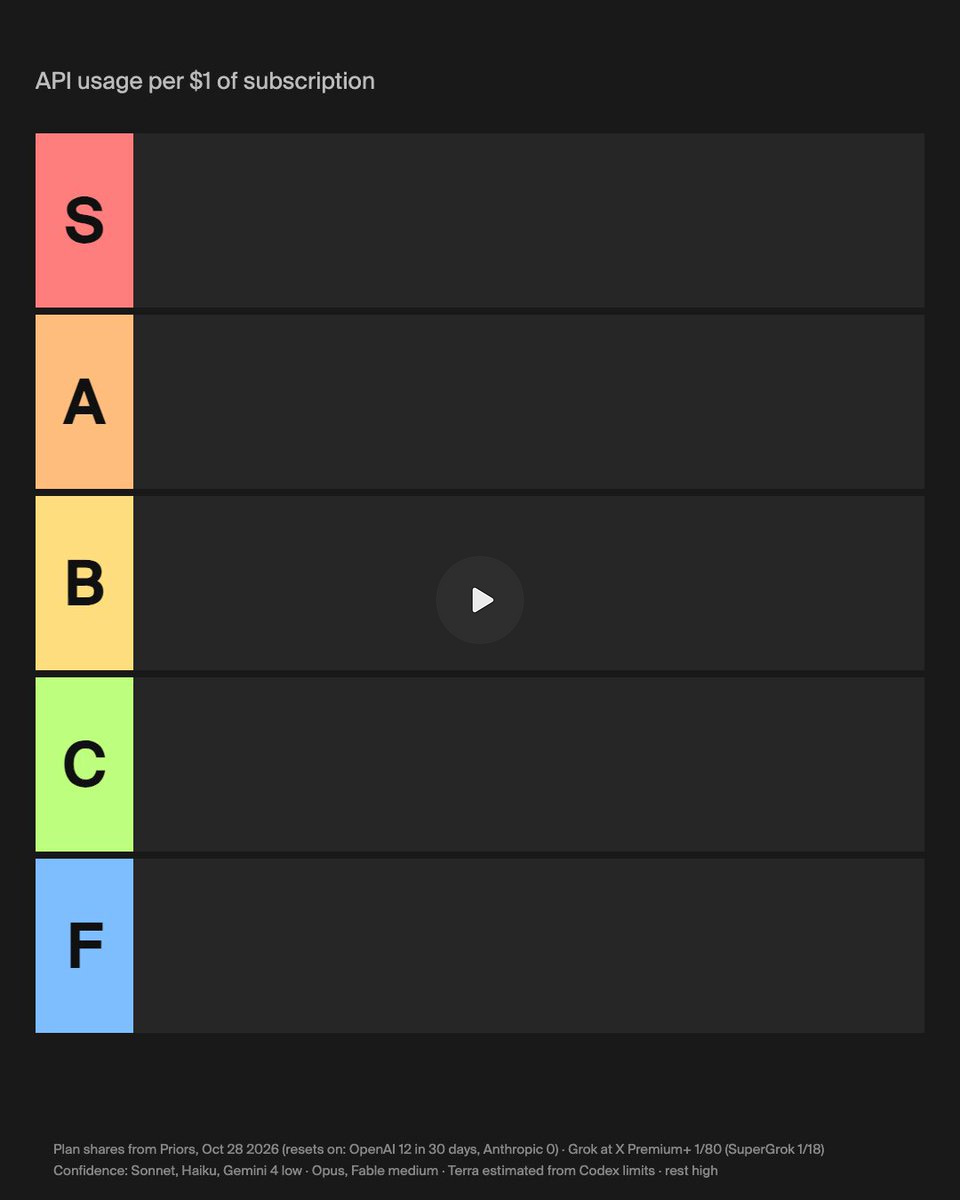
Load your plate now. The plates are being counted.
Department of Token Efficiency
Somebody out there cut their AI bill. Today’s cost destroyer is Guillermo Baigorria, Head of Technology at Werk (his write-up).
His test agent had a timestamp at the very top of every prompt. That one line meant the AI provider could never reuse the cached copy of the prompt. Every call paid to save it. No call ever read it.
He moved the timestamp down and did a few other cleanups. Prompt cost went from $1.76 to $0.48 per thousand calls. That’s down about 73%.
The fine print: a toy agent, two tools, two users, prompt cost only.
So go look at the top of your prompt. Trust nothing.
A word from ourselves
Your smoke detector for a burning budget. Your night-vision goggles for the invoice. Your bolt cutters for vendor lock-in.
Strong Compute plugs into the compute clouds and model providers you already use, from AWS and Lambda to OpenAI and Anthropic. Bring your own keys and see exactly where the GPU hours and tokens go.
Because somebody has to read the invoice.
Try it at strongcompute.com
Keep your context short and your invoices shorter. See you next episode.