

Listen to this episode on Spotify or watch it on YouTube.
Welcome back to The Cost of Intelligence, our comedy news show about the money behind AI. Each episode, Ben Sand reads the industry’s invoice and asks one question: are you getting more intelligence per dollar?
This week: chipmaker Marvell is buying Lumentum to own more of the links between AI chips (turns out the chips needed a better group chat), Oracle paid up to borrow for its data centers, and we learn the cloud has a credit score too. Plus, Grok Bot’s allowance runs out faster, and Elon says it costs too much to serve. Welcome to the affordability crisis, Elon. And from the Department of Token Efficiency: Revolut cut its coding-agent bill by about 90% with one weird free-weights trick. Here’s the written version, with every source linked.
The tokens
By our math, the world is now using about 1.1 quadrillion tokens a day, up about 4 trillion since Monday.
That’s roughly a novel’s worth of words for every human on Earth, every day, by our math. Quite a reading list for a species that skims the terms of service.
The landlord has entered the chat
Agents need an office, and that’s where our landlords, the clouds, come in. The landlord only knocks when the rent’s going up.
On the Ornn Compute Price Index, which tracks actual rentals:
NVIDIA H100 settled Monday (2 November) at $3.38 an hour, up 11.9% since Sunday (Ornn H100). In one day. Even Uber would blush.
H200 is up about 30% in three days, from $5.49 to $7.12 by Monday’s settle (Ornn H200). Somewhere, an H100 just asked for a raise.
B200, the newer chip, slid for the fifth day running to $9.41 (Ornn B200).
Old chips up, new chips down. Vintage is back, baby.
Our studio audience is CFOs, and they’re really excited by this new increase in costs.
Chips, power and the work
Chips. How many chips is the landlord renting out? Epoch AI’s chip-sales data adds up to about 31.6 million H100-equivalents delivered through mid-2026 (Epoch AI). Run our trend of about 5% a month forward and the world is tracking to about 33 million H100-equivalents today, by our math. That’s about one for every 250 people.
Epoch’s last published total is weeks old. In AI years, that’s a geological era.
Power. Epoch turns chip power into data-center power with a 2.5x overhead multiplier for servers, networking and cooling (Epoch AI). Off the same Epoch count and the same trend, AI data centers are tracking to about 51 gigawatts today, by our math. That’s about 6 watts for every person on Earth: one LED bulb each, around the clock.
The work. On our bet, all that gets you 28% of the hours we work, or about 98 minutes a day for each of the roughly 3.6 billion of us still working. That’s up a fifth of a point, and about a minute, since Monday.
The news
Marvell buys Lumentum
Chipmaker Marvell is buying Lumentum, an optical components maker whose lasers and optical transceivers carry the data between GPUs. The price: an implied enterprise value of about $115 billion, all in stock, at 4.5 Marvell shares for each Lumentum share (Marvell).
That’s more than twice what AMD paid for Xilinx, about $49 billion, which was the biggest chip deal ever when it closed in 2022 (Electronic Design). Broadcom once bid more, $117 billion for Qualcomm, but the White House blocked it (TechCrunch).
The bigger bid never happened. Very on brand for AI.
Why it matters for your bill: the chips are only as fast as the links between them, and those links are a bottleneck. Your chips are Ferraris trying to share the bike lane.
The deal is all stock and isn’t expected to close until the first half of 2028 (Marvell), so that price moves with Marvell’s shares until then.
Per-dollar verdict: the chip shop is buying the optics shop. Fewer suppliers, less haggling. Well, less haggling for them. You still get to haggle, just with fewer people.
Who’s paying for the concrete?
Oracle just priced a $20 billion raise: about $10 billion in new stock at $116 a share, plus $10 billion of bonds with coupons from 7% up to 8.65% (Reuters via Investing.com).
At that rate, Oracle is financing the data center on a store card. Stock in the front, bonds in the back. The financial mullet.
The stock fell 8.8% on Monday (CNBC). A company called Oracle, and no one saw it coming?
Everybody’s borrowing. S&P rates Oracle BBB-, one notch above junk (The Next Web), and its bonds due 2031 already yield about 7.3% (CNBC). In wine terms, it’s a very confident box.
So the landlord rents you the chips by the hour, and the bond market rents the landlord the money by the year. Turns out the landlord has a landlord, and his landlord doesn’t fix the AC either.
Per-dollar verdict: the cost of capital is part of the cost of the compute, and it just got costlier.
Our last story: Grok Bot’s meter
This weekend, Grok Bot users said their weekly allowance was running out days early (The Next Web). Like a paycheck. You know the feeling.
On Sunday, when a subscriber asked for a reset, Elon Musk replied: "The cost of serving Grok Bot was unsustainably high relative to revenue" (Elon Musk on X).
Every CFO here has written that exact sentence. You just didn’t get to post it.
Last Thursday, Elon said "saving money for the distant future is pointless with the advent of super intelligent abundance" (Elon Musk on X). As for today, though, he is once again asking for your financial support.
Full disclosure: this show gets written with Grok Bot’s help, and today’s episode ends early. You know why. Which puts our own tier list on the spot.
Per-dollar verdict: dumber per dollar for Grok Bot users this week. Same price, and the allowance runs out sooner. Shrinkflation, now for thinking.
The tier list
How much API usage you get for every dollar of subscription, on our list built from Adam Holter’s (Adam Holter; Claude pricing):

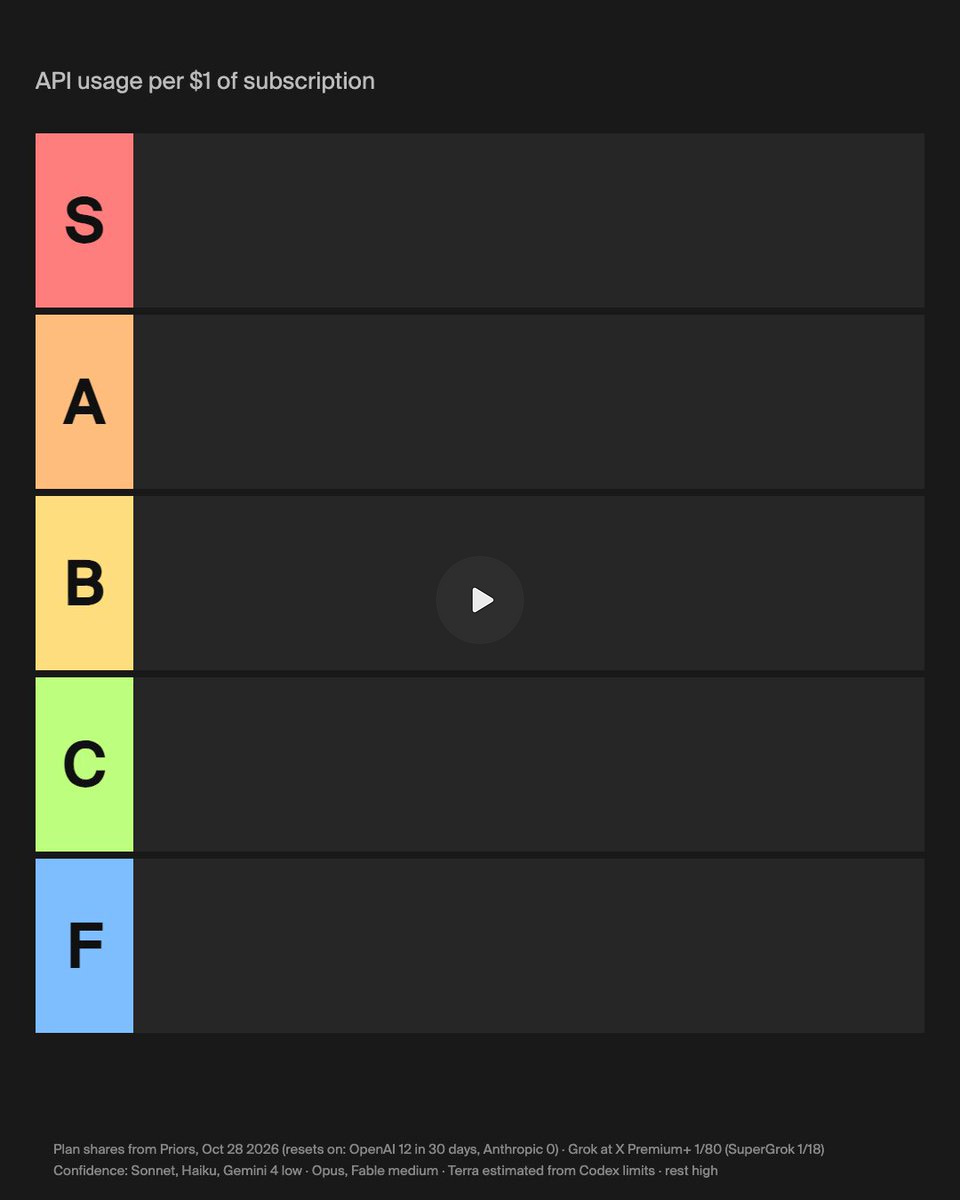
Top of S tier: still Claude’s $100 Max plan, at about $77 of API usage per subscription dollar. If your pension did that, you’d retire Friday.
Then: Claude Ultra, Claude Pro, and Google’s $200 AI Ultra.
Mover: X’s Ultra plan is leaving fifth place, because this is where the Grok Bot shrinkflation lives. Before this weekend it came in at $44 or more of API per dollar. From the cries of pain on X since the Grok Bot changes, it could easily be half that, on our bet.
Rounding out the top ten: ChatGPT’s two Pro plans ($200 and $100), X’s Super plan, Google’s AI Pro, and Google’s $100 Ultra.
Google has almost as many things called Ultra as it does things called Gemini. If you find a good name, use it for everything.
At least this board has held fairly steady since our first count four days ago. That’s the calmest thirty seconds in AI this week. Deep breath. Hold it. Hold it. Okay, that’s enough. The landlord charges for air too.
Department of Token Efficiency
Somebody out there cut their AI bill. Today’s cost destroyer is Revolut. Yes, a bank. The industry that invented the overdraft fee is on our side today.
David Abitbol, Ops & Infrastructure Leader at Revolut, told AI Engineer in New York how Revolut moved about 2,000 engineers’ coding agents off the big closed labs and onto GLM (AI Engineer NYC), Z.ai’s free-weights model (Z.ai on Hugging Face).
They run it on 56 dedicated NVIDIA B200s (AI Engineer NYC). That’s about 36 engineers per chip, by our math: same as a coffee machine, and just as hot.
Running it themselves costs a blended $0.30 per million tokens. Couch-cushion money, and a long way from anyone’s list price. In his words: "Our invoice is one-tenth of what we were spending on Anthropic and OpenAI" (AI Engineer NYC).
The fine print: you can’t run the experiment you’re not paying for, so nobody knows how much better the frontier models would have been. Side effects may include smugness at your next vendor renewal.
Still, a regulated bank on stage, saying it out loud. Somewhere, an enterprise account rep is updating their LinkedIn.
A word from ourselves
Your itemized receipt for the cloud bill. Your bank alert for every surprise charge. Your move-out photos, so the landlord can’t keep the deposit.
Strong Compute plugs into 21 compute clouds and 5 model providers you already use, from AWS and Lambda to OpenAI and Anthropic. Bring your own keys and see exactly where the GPU hours and tokens go.
Because somebody has to check the meter. And to the landlord, if you’re listening: the AC is still broken.
Try it at strongcompute.com
Keep your context short and your invoices shorter. See you next episode.