

Listen to this episode on Spotify or watch it on YouTube.
Welcome back to The Cost of Intelligence, our comedy news show about the money behind AI. Each episode, Ben Sand reads the industry’s invoice and asks one question: are you getting more intelligence per dollar?
This week: after the midterms, the Nasdaq had its worst day in more than a year. If data centers are the economy, then no data centers, no economy. Anthropic’s amended IPO filing puts a number on its compute bill: most of the revenue goes to compute, and the rest goes to apologizing for rate limits. Microsoft passed on more than doubling its Texas deal with Nscale, a heartwarming case of empathy with the midterm voter. And from the Department of Token Efficiency: Opscale says its own tool cut about 20% off one Claude Code run. Here’s the written version, with every source linked.
The tokens
Markets fell, and you kept typing. You’ve been using about 460 trillion tokens a day, by our projection of tokensperday.com. The tracker’s headline figure is a July estimate of about 360 trillion a day; we grow it about 7% a month to today. That growth rate is ours, not the tracker’s (methodology).
That works out to about 55,000 tokens per person per day. Fifty-five thousand each, and most of you were just typing "thanks".
The tracker’s own capacity check says the world’s hardware could produce about 691 trillion tokens a day, based on about 16 million chips (its middle case, methodology). Start from our 35 million chips instead and scale straight up, and it’s well over a quadrillion potential tokens a day, by our rough math.
Potential tokens. Much like a gym membership, they’re mostly potential.
The landlord’s rate card
Agents do need an office, and that’s where our landlords, the clouds, come in. On the Ornn Compute Price Index, which tracks actual rentals:
NVIDIA H100 settled at $3.13 an hour on 5 November, down about 11% on the day, but still up about 7% on the week and about 10% on the month (Ornn H100).
B200 settled at $9.46, up a penny on the day, down about 4% on the week, and up a full 25% on the month (Ornn B200).
The landlord has entered the chat. "A discount? I’m sorry, I don’t know the word." Cheaper for one day, but the landlord calls it a clerical error.
Our studio audience is CFOs, and they’re really happy about that 25% increase. Today, the penthouse tenants don’t get to haggle.
Chips, power and the work
Chips. About 35 million H100-equivalents is our estimate. Epoch AI’s data center tracker counts about 15.8 million at the sites it follows, which Epoch estimates is about 45% of the world’s AI compute; we scale up from there. That’s one chip for every 240 people. Please form an orderly queue.
Power. Those chips draw about 30 gigawatts, by our estimate of what the sites actually use. Their total capacity is closer to 44 GW (Epoch AI). Somewhere a space heater is shivering.
The work. On our bet, AI is doing about 11.5% of the hours we work. Spread over the week, that’s about 40 minutes a day for every worker still clocking in, and our trend has that share growing about 7% a month. Forty minutes a day: roughly one meeting that could have been an email.
The news: voters sink the chip stocks
Voters sided against data centers on about 40 of 41 local ballot measures, by preliminary counts (Route Fifty; FourWeekMBA). Goldman Sachs says Democratic control in the leading data center states could affect about 45% of planned US data center capacity (as relayed by FourWeekMBA).
Investors heard those votes and acted. On Thursday:
The chip index (the PHLX Semiconductor Index) fell about 12% (CoinCentral).
The Nasdaq fell 5.5%, its worst day since April last year (La Nación; CoinCentral).
CoreWeave slid about 10% (CoinCentral).
NVIDIA alone lost more than $440 billion of market value (Benzinga).
Jensen’s jacket will need elbow patches.
The market sold the future in one afternoon, but something tells me we’ll be back. Ethan Mollick, who teaches at Wharton, put it this way:

Translation: in the short term, the market is a voting machine. In the long term, it’s a von Neumann machine.
Per-dollar verdict: stocks are a mood, invoices are a contract.
The books: Anthropic’s compute bill
Anthropic’s amended IPO filing (S-1/A, filed 2 November) shows:
Third-quarter revenue of nearly $17 billion ($16.96B), up about 47% from the second quarter. The quarter before that was up 144%, so growth is slowing, from the highest of bases.
Compute and infrastructure cost nearly $10 billion ($9.86B). That’s 58 cents of every revenue dollar.
About $895 billion of committed spend, substantially all of it compute and infrastructure. About half is expected after 2030, and only about 24% can be cancelled or depends on conditions.
If up 47% counts as slowing down, someone needs to get them some new tires.
Per-dollar verdict: the IPO sells you the future that the landlord already billed for.
Microsoft passes on Nscale
Microsoft passed on the option to more than double its Texas deal with Nscale, an option the Financial Times says was worth tens of billions of dollars (MLQ.ai; Global Banking & Finance). Reuters reports the decision was made months ago.
Not to worry: Nscale lists about $103 billion of active and contracted deals (Pulse 2.0). For now, the money runs the other way. Nscale lost about $1 billion in the first half of this year on revenue of about $140 million (RuntimeWire).
Big backlog, small revenue. The waiting list is much longer than the guest list.
Per-dollar verdict: a backlog is a promise, a loss is a receipt.
The tier list
Come on down. How much API value you get for every subscription dollar, on our list built from Adam Holter’s and real API pricing (Adam Holter; Claude pricing). It ranks value, not what people use, and the split by model is our own.

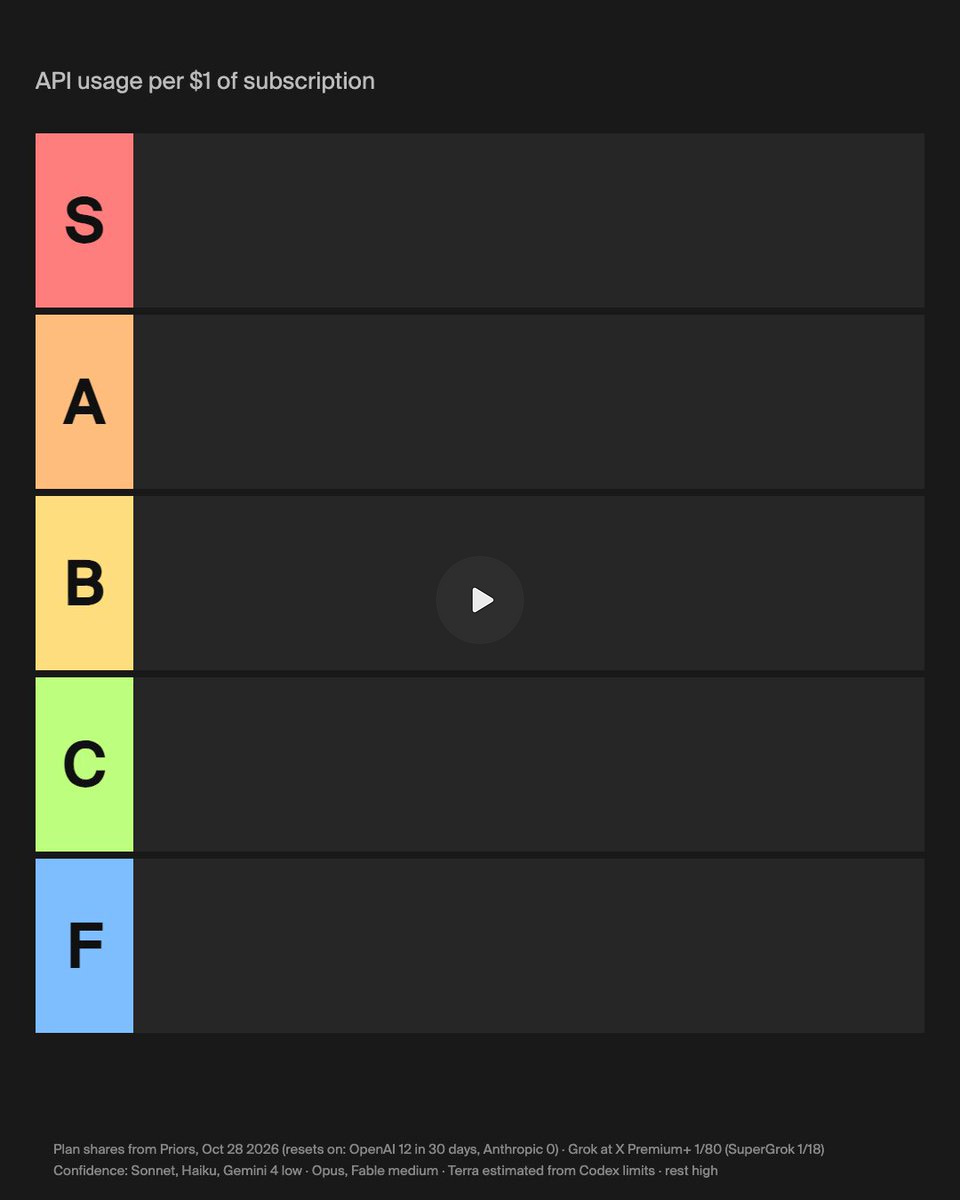
Top of the list: Claude Max with Opus, at about $77 of API value per dollar.
The rest of the top ten: Max with Sonnet, Ultra with Opus, Ultra with Sonnet, Pro with Opus, Pro with Sonnet, Max with Haiku, Google’s AI Ultra 20x plan, Ultra with Haiku and Pro with Haiku.
Nine of the top ten rows are Claude. The other one is Google holding the door.
Department of Token Efficiency
Somebody out there cut their AI bill. Let’s honor them the only way we know how. (Chainsaw. Watch the video.)
Today’s cost destroyer is Opscale and its tool for coding agents. In Opscale’s own test across 89 benchmark tasks, one Claude Code run cost $35.35, and $28.30 with its tool. That’s about 20% off.
The trick: Claude Code’s prompt cache expires after five minutes of waiting by default (Anthropic docs), and then the agent pays to write the prompt again. Opscale’s tool pings the cache while the agent waits on a slow task, and trims the prompt too. Opscale says about half the saving is the cache trick.
And you know who lives in that cache. Expired? Pay again? Delicious. The cache went to get coffee, and the credit card went with it.
The fine print: Opscale makes the tool and ran the test. It was one benchmark, not a real bill, and four tasks made most of the difference. We couldn’t find Opscale’s write-up online, so these are its numbers as reported to us. Side effects may include a very warm cache.
Still: goblin evicted, and chainsaw approved.
A word from ourselves
Your magnifying glass for the footnotes. Your seat belt for a bumpy quarter. Your smoke alarm for the burn rate. The people who keep the landlord honest.
Strong Compute plugs into 21 compute clouds, from Crusoe to Nebius to Modal, and 5 model providers, from Gemini to xAI to Fireworks. Bring your own keys and see exactly where the GPU hours and tokens go.
Because somebody has to read the bill.
Try it at strongcompute.com
Keep your context short and your invoices shorter. See you next episode.